
Secured financing
This type of facility is supported by security. The verified maximum rate shown for secured loans is up to 12% p.a.; the structure available in a particular case depends on individual assessment.
Debt consolidation Malaysia
Debt consolidation generally combines several existing balances or repayments into one financing arrangement. It does not make debt disappear, and any option, rate, tenure and total repayment are subject to individual assessment.
Private conversation. No obligation to proceed.
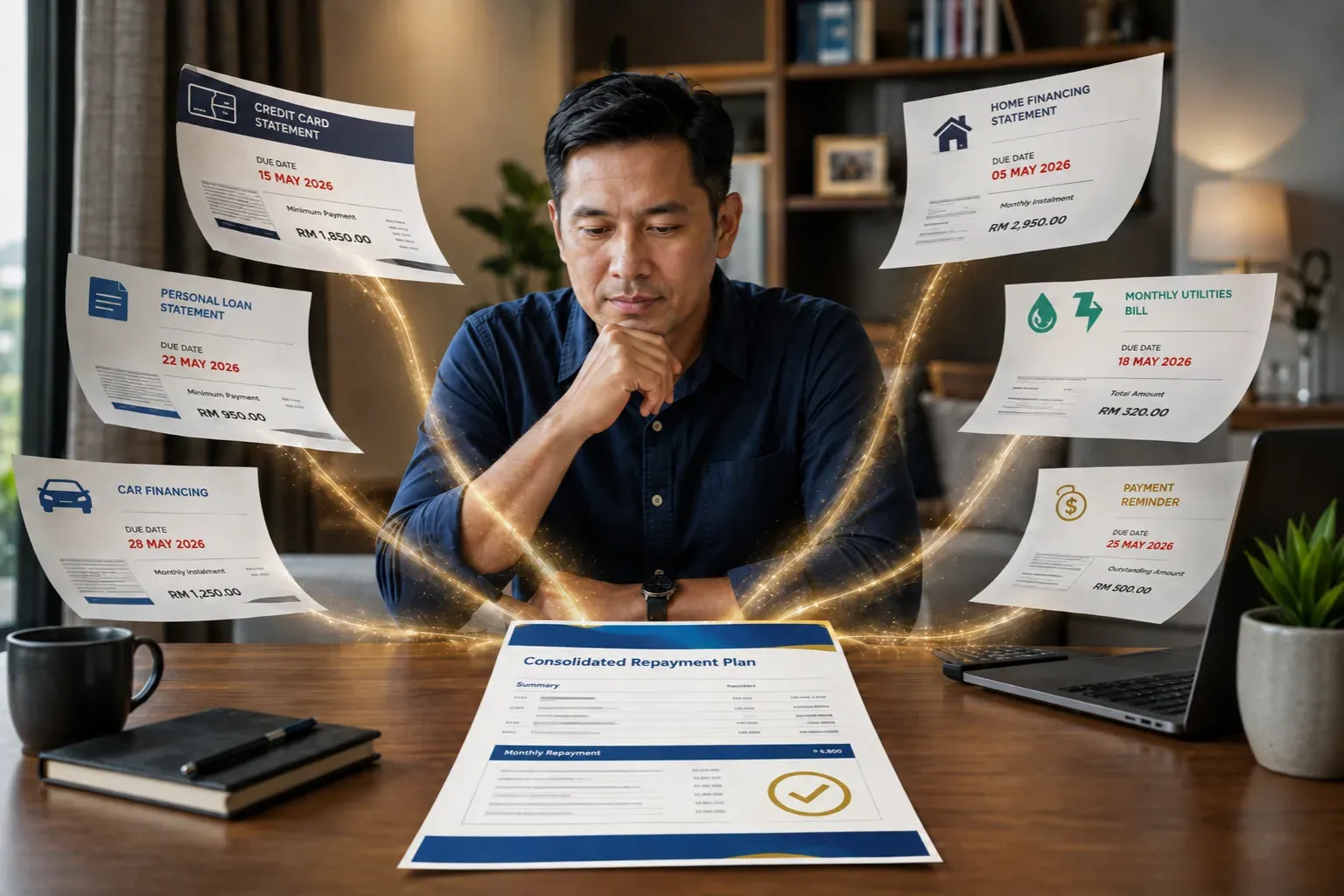
It is a way to review whether several repayments could be brought into one structured arrangement. It is not a promise that every debt can be included, that a payment will be lower, or that an application will be approved.
People often begin with credit card balances, existing personal-financing commitments or other monthly repayments that feel difficult to keep track of. The useful starting point is a complete picture of the balances, monthly payments, tenure and total cost, not just the next payment due.
List your current repayments to see the broad picture before you discuss it with anyone. This worksheet stays in your browser, is not sent to 96 Century, and does not assess eligibility or recommend a product.
Enter whole amounts in ringgit and an optional annual interest rate as shown on each statement.
For reliable on-device arithmetic, each amount is limited to RM10,000,000. This is a technical worksheet input limit, not a product maximum.
Interest rates are recorded only for reference. Rate formats can differ, so this worksheet does not calculate a combined rate or savings.
Total outstanding debt entered
Total monthly payments entered
Your entries and any downloaded Excel-compatible file stay in your browser until you choose to share them. They are not stored, transmitted or used to make an eligibility decision.
This illustration uses the total outstanding debt entered in the worksheet above and a tenure you select. It is not a quote or offer.
Illustration only: not a quote or offer
Uses a flat rate of 18% p.a. and the total outstanding debt entered above.
Flat-rate interest
Total repayment
Approx. monthly repayment
This amount follows your worksheet until you adjust it. An adjustment changes this illustration only and is not a quote or offer.
This illustration calculates simple flat-rate arithmetic from the worksheet total at 18% p.a. The rate, amount, tenure and repayment that may apply are subject to individual assessment, approval and the final loan agreement. Terms and conditions apply.
Start with balances, monthly payments and any questions about the commitments you are carrying.
A consultant can explain the information needed for an individual assessment and whether one structured arrangement may be available.
If terms are available, compare the rate, tenure, total repayment and how existing balances would be handled before you commit.
Both deserve a calm comparison. Debt consolidation is a financing discussion; AKPK provides free financial advisory services and debt-management support.
| Consideration | Debt consolidation | AKPK support |
|---|---|---|
| What it is | A discussion about whether several repayments could be brought into one financing arrangement. | Free financial advisory services and debt-management support from AKPK. |
| What to compare | The applicable rate, tenure, total repayment and how existing balances would be handled. | The guidance and support available for your circumstances. |
| Starting point | A private conversation and individual assessment. | Review AKPK’s official information or contact AKPK directly. |
Read the Malaysian Government’s AKPK advisory information . This comparison is general educational information, not financial advice.
The structure matters as much as the rate. Ask how the arrangement is structured and read the written terms before deciding.
This type of facility is supported by security. The verified maximum rate shown for secured loans is up to 12% p.a.; the structure available in a particular case depends on individual assessment.
This type of facility does not use security in the same way. The verified maximum rate shown for unsecured loans is up to 18% p.a.; individual assessment still determines what may apply.
The following verified checklist helps a consultant understand your situation. It is not a promise of eligibility or approval.
Copy of IC, front and back.
Latest 3 months' payslips.
Latest 3 months' bank statements.
Latest water or electricity bill.
Latest EPF statement (2025/2026).
For your security, do not share banking passwords, OTPs or login details. A consultant can explain how any relevant documents should be handled.
You do not need to decide anything in the first conversation. Ask what the structure could involve, then take time to consider the written details.
The same answers below are included in this page’s FAQ structured data.
Debt consolidation generally means combining several existing balances or repayments into one new financing arrangement. Whether an arrangement is available, and its amount, rate, tenure and total repayment, are subject to individual assessment and the final loan agreement.
You can start by outlining the repayments that are difficult to manage, such as credit card balances or existing financing commitments. A consultant can explain what information is relevant, but this conversation does not determine eligibility or guarantee that every balance can be included.
A lower monthly repayment is not guaranteed. A longer tenure can change the monthly amount while also changing the total amount repaid, so compare the rate, tenure and total repayment in writing before deciding.
Debt consolidation is a financing option that may combine repayments into one arrangement. AKPK provides free financial advisory services and debt-management support; the appropriate path depends on your circumstances, and you can review both before deciding.
Yes, you can start a conversation. CCRIS, CTOS records or a previous rejection do not by themselves determine every enquiry, but every case is assessed individually and approval is not guaranteed.
The current checklist is: identity card (Copy of IC, front and back.), payslips (Latest 3 months' payslips.), bank statements (Latest 3 months' bank statements.), utility bill (Latest water or electricity bill.), epf statement (Latest EPF statement (2025/2026).). These documents support an assessment; a consultant can explain what is relevant to your situation.
The verified maximum rates are up to 12% p.a. for secured loans and up to 18% p.a. for unsecured loans, with tenures from 6 to 60 months. The rate and tenure that apply to an individual case are set out in the final loan agreement.
Use the official WhatsApp or office call links on this website. There are no upfront fees to enquire or have your situation assessed. Do not share passwords, OTPs or banking login details, and be cautious of anyone promising a particular outcome or asking for money before a loan is released.
Names have been changed to protect our clients' identities.
Client testimonials advance automatically.
“Saya ada terlalu banyak komitmen setiap bulan dan memang susah nak urus. Team 96 Century terangkan satu-satu dan saya jadi lebih faham pilihan yang ada.”
“What I liked most was they didn't pressure me. They asked about my situation first and explained the process clearly before I decided anything.”
“之前我对债务整合不是很了解,跟他们谈过之后才比较清楚整个过程。服务很有耐心,也不会一直催我做决定。”
“Saya berniaga sendiri dan perlukan tambahan modal. Proses penerangan sangat mudah, dan team mereka cepat respon bila saya ada soalan.”
“I had spoken to a few places before but still felt confused. Here, they took the time to explain the numbers and what I needed to prepare.”
“整个过程没有我想象中那么复杂。先了解我的情况,然后再解释适合的选择。最重要是不会给我压力。”
“Saya suka sebab mereka sangat terus terang. Mereka tak janji macam-macam, tapi tengok situasi saya dulu dan terangkan apa yang boleh dibuat.”
“As a business owner, I wanted something straightforward. The team was responsive and explained the financing options in a way that was easy to understand.”
“之前每个月的还款让我压力很大。跟顾问谈过后,至少我更清楚自己接下来应该怎么处理。”
“Team sangat friendly dan senang nak berbincang. Penerangan jelas, tak rasa kena paksa dan saya boleh fikir dulu sebelum buat keputusan.”
Empowering Your Credit
Talk to 96 Century privately about debt consolidation in Malaysia. We can explain the next step before you decide whether to proceed.
No obligation to proceed.
You can also explore personal loans in Malaysia or contact 96 Century.
· General educational information only; it is not financial advice. For a general description of debt-consolidation financing, see Bank Rakyat’s debt-consolidation information .